Shopney vs Tapcart: Shopify App Builders Compared
Shopney starts at $149 a month with a 30-day trial; Tapcart starts at $500. We compare plans, first-year cost, feature tiers, launch steps and who each Shopify app builder suits, from their own pages.
On this page
- Shopney vs Tapcart at a glance
- How much do Shopney and Tapcart cost?
- How much will each cost in the first year?
- What does each entry plan include?
- Which features cost more as your store grows?
- How does launch work with each?
- Who should choose Shopney, and who should choose Tapcart?
- Where does AppSorcerer fit?
- Frequently asked questions
- Which is cheaper, Shopney or Tapcart?
- Do Shopney and Tapcart build iPhone and Android apps?
- Does Shopney or Tapcart take a cut of sales?
- Can I switch from Tapcart to Shopney without losing my listing?
Shopney and Tapcart both turn a Shopify store into a native shopping app for iPhone and Android, and both bill through your Shopify invoice. So Shopney vs Tapcart mostly comes down to budget and team size: Shopney's plans start at $149 a month, Tapcart's at $500. We read both vendors' pricing and feature pages in November 2026 to compare what each plan includes, what costs extra as you grow, and how launch works.
Short answer: Shopney is the better fit for small and mid-sized Shopify stores: plans start at $149 a month, there's a 30-day free trial, and design help is included. Tapcart starts at $500 a month and suits established brands that want deeper analytics, testing, whole-team access and developer tools. Both build iPhone and Android apps and bill through Shopify.
Disclosure: AppSorcerer also makes apps for Shopify stores, but a different kind, and only for Android today. We keep it out of the head-to-head and explain where it fits near the end.
Shopney vs Tapcart at a glance
Every price below is the vendor's own list price in US dollars, before tax, read on shopney.co/pricing and tapcart.com/pricing at the time of writing (November 2026).
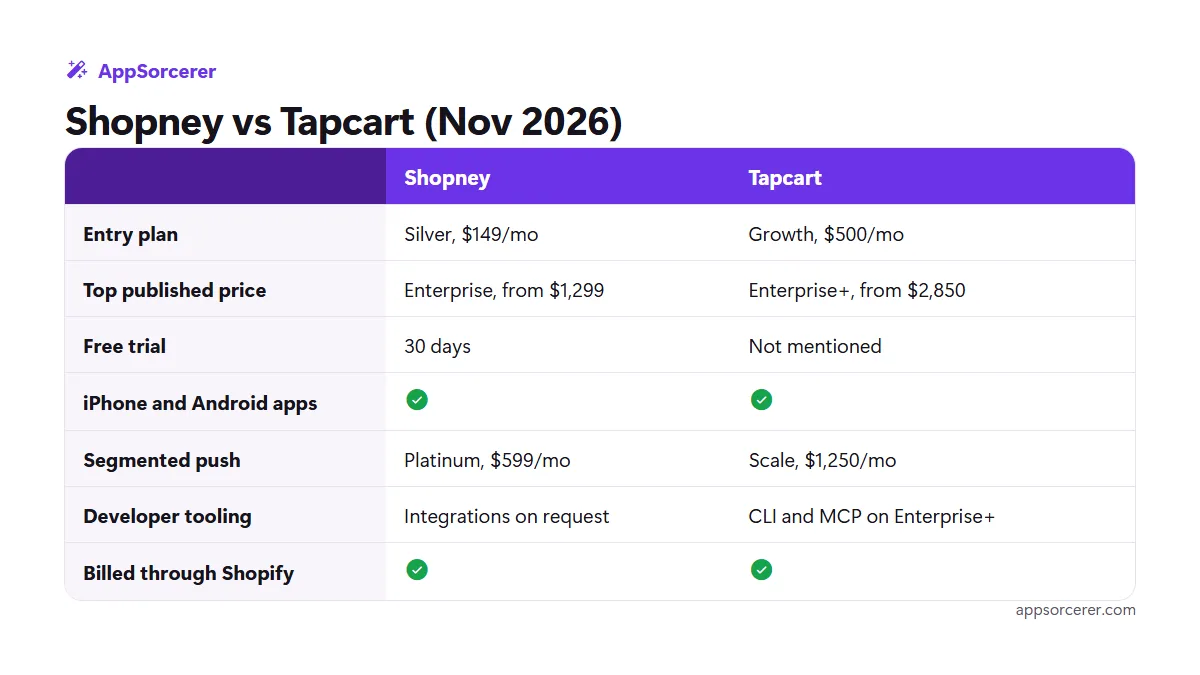
| Shopney | Tapcart | |
|---|---|---|
| Entry plan | Silver: $149 a month, or $119 a month billed yearly | Growth: $500 a month |
| Higher plans | Gold $299, Platinum $599, Enterprise from $1,299 | Scale $1,250, Enterprise+ from $2,850 |
| Free trial | 30 days | None mentioned; demos on request |
| Apps | White-label iPhone and Android apps on every plan | iPhone and Android apps on every tier |
| Stores supported | Shopify and Shopify Plus | Shopify only |
| AI extras | AI app builder; AI push from Platinum | AI add-on for $250 a month on any plan |
| Changing plans | Cancel or freeze any time | Switch any time, pro-rated charge or refund |
| Developer accounts | Your own Apple ($99 a year) and Google Play ($25 once) | The same, required on every plan |
How much do Shopney and Tapcart cost?
Shopney has four tiers: Silver at $149, Gold at $299, Platinum at $599 and Enterprise from $1,299 a month. Paying yearly brings those down to $119, $239, $499 and $999 a month. Tapcart has three: Growth at $500, Scale at $1,250 and Enterprise+ from $2,850 a month, plus an optional $250 AI add-on covering AI-written pushes, content syncing and generated images and video. Tapcart's page has an annual billing line, but it didn't show a usable figure when we checked, so the numbers here are monthly.
How much will each cost in the first year?
| Setup | Year one, before tax |
|---|---|
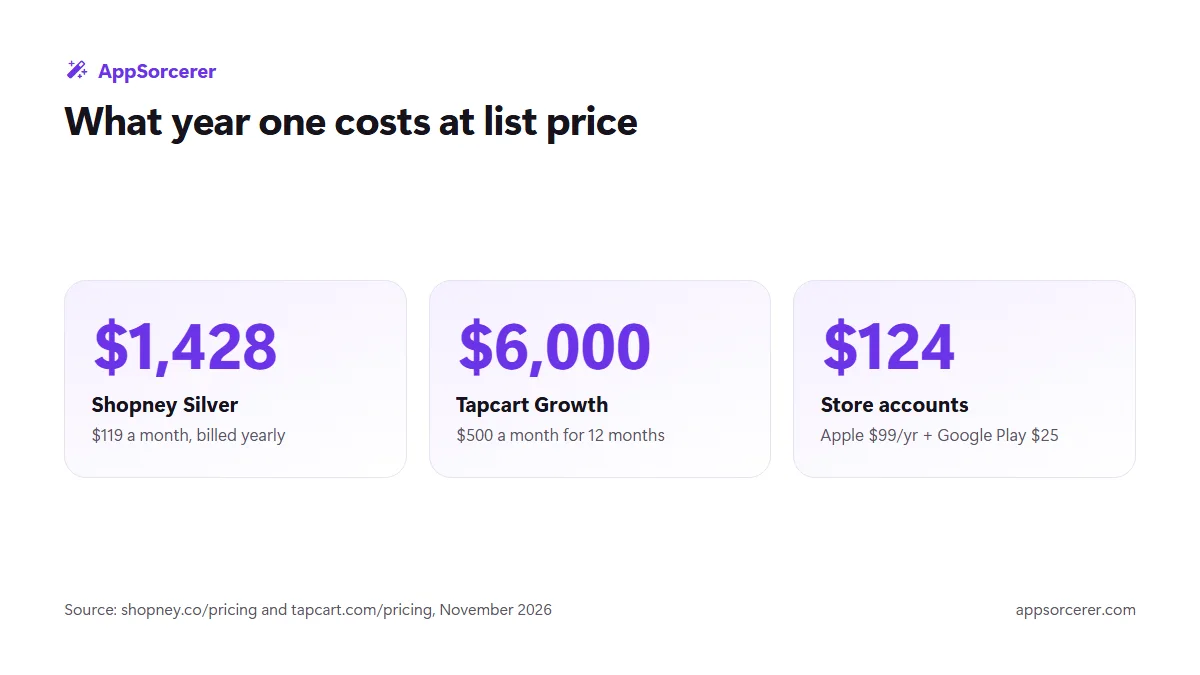
| Shopney Silver, billed monthly | $1,788 |
| Shopney Silver, billed yearly | $1,428 |
| Shopney Gold, billed yearly | $2,868 |
| Tapcart Growth | $6,000 |
| Tapcart Growth with the AI add-on | $9,000 |
Add $124 for the store accounts in year one in every case: Apple's $99 yearly fee and Google Play's one-time $25. Apple's fee comes back every year; Google's doesn't.
What does each entry plan include?
Shopney Silver is a complete starter app. It covers unlimited and rich push notifications, back-in-stock alerts, in-app chat and campaigns, layout options for product and collection pages, Google Analytics and Facebook Ads integration, localisation in 21 languages and app-exclusive discounts. Shopney also lists expert design support and 24/7 live chat on every plan. The gap that matters most for a store is abandoned-cart push, which starts on Gold.
Tapcart Growth is generous on content. You get unlimited blocks, integrations, push notifications and custom screens, AI-assisted editing, product badges and gift-with-purchase, round-the-clock support and a managed Apple and Google developer portal. Tapcart's FAQ says its one-step checkout handles Apple Pay, PayPal, Google Pay and Amazon Pay. The catch is people: Growth comes with one team member account.
Which features cost more as your store grows?
This is where the two products separate. Here's where common features sit, from the two pricing pages and Tapcart's feature list:
- Abandoned-cart push: Shopney Gold ($299). Tapcart lists cart-abandonment automations among its push features, and its pricing table includes unlimited push from Growth, but it doesn't tie automations to a tier, so ask.
- Segmented push: Shopney Platinum ($599), alongside AI-generated pushes. At Tapcart, user segmentation is a Scale feature ($1,250).
- Analytics and testing: Tapcart Scale adds realtime analytics, heatmaps, scroll maps and A/B tests. Its feature page marks A/B testing "Enterprise only" while the pricing page lists it under Scale, so confirm which applies before you plan around it.
- Marketing integrations: Shopney puts Klaviyo, Rebuy, Nosto, loyalty and subscription integrations on Platinum. Tapcart includes unlimited integrations from Growth.
- Team access: Tapcart opens the dashboard to your whole team on Scale. Shopney's pricing page doesn't list seat limits.
- Developer tools and scale: Tapcart Enterprise+ adds its developer tools and CLI, data streaming to a warehouse and a 99.99% uptime SLA. Shopney Enterprise adds multi-store support, AppsFlyer and Adjust, and a dedicated success manager.
One pattern worth noticing: if you need Klaviyo or loyalty integrations from day one, the price gap shrinks. Shopney Platinum costs $599 a month, while Tapcart Growth costs $500 with unlimited integrations included. Below that level, Shopney is far cheaper for a similar app.
How does launch work with each?
Both vendors publish the app under your own developer accounts, so the listings and reviews belong to you. Beyond that, the routes differ:
- Tapcart: Growth includes a managed developer portal, and its implementation managers help set up the accounts. Its FAQ says an iOS launch needs a registered company (an LLC or corporation, or your country's equivalent), a D-U-N-S number and an Apple Developer account. For Android, the Google Play account is enough.
- Shopney: its team handles store submission, and its home page says apps can go live on iOS and Android in as little as 5 days (shopney.co). Treat that as the vendor's best case.
Google adds a step of its own for newer personal accounts, those opened after 13 November 2023: a closed test that keeps at least 12 testers opted in for 14 straight days before production access. Organisation accounts are exempt (Play Console Help). If you're on a personal account, our 12-tester guide explains how to run that test.
Switching later is possible. Tapcart's FAQ says it can migrate an existing app and keep its users and push subscribers. Shopney's Tapcart migration page promises no migration fee and says the app keeps its store listings, reviews and users. Both claims depend on the app living in your own Apple and Google accounts.
Who should choose Shopney, and who should choose Tapcart?
Choose Shopney if you're a small or mid-sized store, your app budget is a few hundred dollars a month, and you'd like design help and a 30-day trial before you pay. Start on Silver, and move to Gold when abandoned-cart push is worth $150 a month more to you.
Choose Tapcart if the app is already a planned sales channel with its own budget, your marketing team will use segmentation, heatmaps and testing every week, or your developers want to build custom blocks. Tapcart's case studies feature established direct-to-consumer brands such as LSKD, Princess Polly and OluKai, which tells you who it's built around.
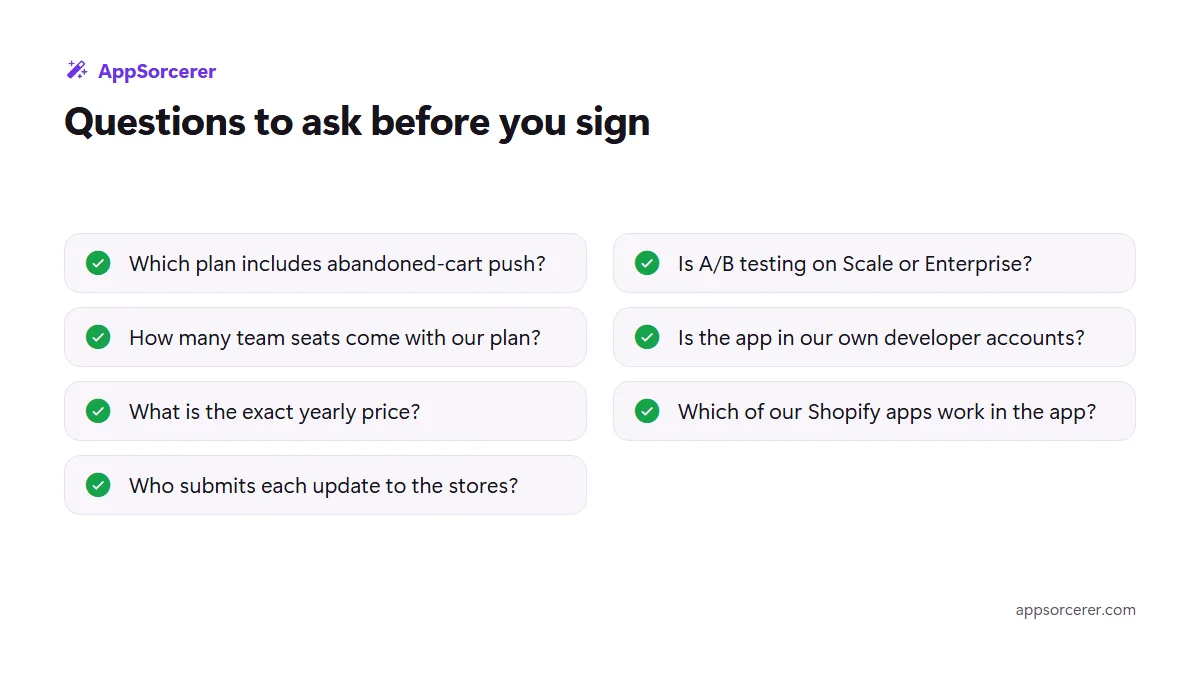
Whichever way you lean, take these questions into the demo:
Where does AppSorcerer fit?
Shopney and Tapcart draw their own native screens and fill them with Shopify data. AppSorcerer takes a different route: it shows your live storefront inside a native Android app with tabs, push notifications and an offline screen, so your theme and storefront apps keep working as they do on the web. The trade-off is speed, since your mobile site sets the pace of the whole app. AppSorcerer also builds Android apps only today, with iOS builds coming soon.
The Free plan gives you Android test builds, Starter ($6 a month) adds store-ready AAB builds, Growth ($9) adds push campaigns and automations, and Pro is $29. Shopify merchants pay through Shopify. You connect the store and open AppSorcerer from the Shopify admin to sign in. Push notifications work today, and apps built from November 2026 on can send back-in-stock and price-drop pushes. Abandoned-cart pushes come with Growth. They already work on development stores, and on live stores they'll switch on once Shopify approves our access to order data; that approval is pending. AppSorcerer isn't listed on the Shopify App Store yet; that's coming soon.
For a wider view of what Shopify app builders charge, including builders that take a share of sales, see our Shopify mobile app builder pricing comparison.
Frequently asked questions
Which is cheaper, Shopney or Tapcart?
Shopney, by a wide margin at list price. Its Silver plan is $149 a month against $500 for Tapcart Growth, and yearly billing takes about 20% off Shopney's prices. Even Shopney Platinum, at $599, costs less than half of Tapcart Scale.
Do Shopney and Tapcart build iPhone and Android apps?
Yes. Shopney lists white-label iOS and Android apps on every plan, and Tapcart says every tier includes both. You still pay Apple and Google directly for your developer accounts.
Does Shopney or Tapcart take a cut of sales?
Shopney's pricing page says it charges no commissions or success fees. Tapcart's pricing page describes a monthly subscription billed through Shopify and lists no sales fee. Enterprise+ has custom contracts and billing, so read that contract closely.
Can I switch from Tapcart to Shopney without losing my listing?
Shopney says yes, with no migration fee, and that the app keeps its listings, reviews and users. That only works when the app is published under your own Apple and Google accounts, so confirm that before you cancel anything.
If most of your shoppers use Android and you want to see a store app working before you commit hundreds a month, start a free AppSorcerer build and compare it with a Shopney trial. Every plan is listed on the pricing page.